Tag Archives: Book Review

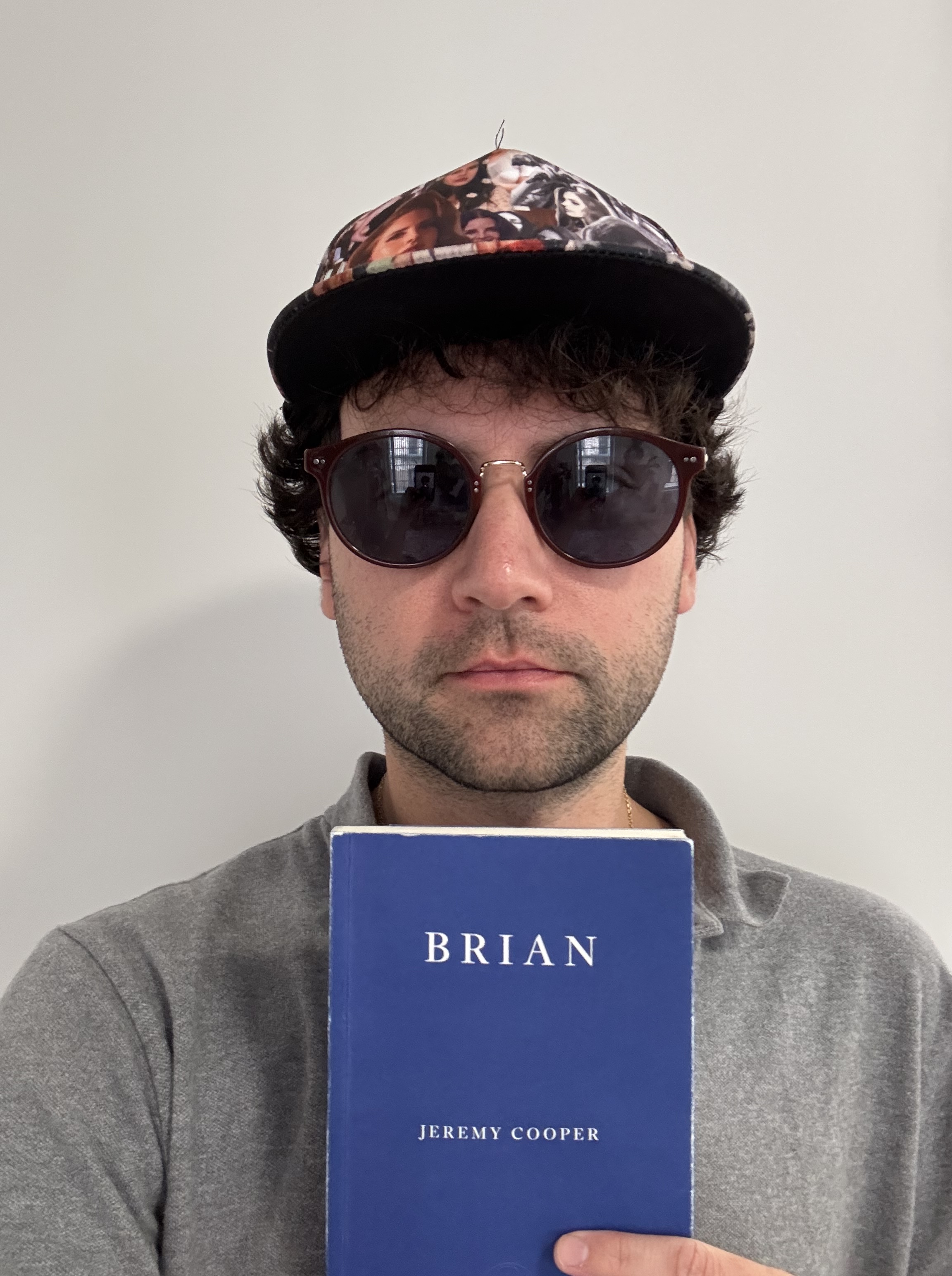
Book Review: Brian

Brian by Jeremy Cooper
A Review by G. Gordon Gritty

I read a review or a short blurb of Brian in the New Yorker a few months ago. The description immediately caught my eye – a lonely British man takes up going to the cinema on a daily basis. Or something like that. It was a compelling description; enough for me to immediately try to acquire a copy, but no luck. All sold out. 

Since I’ve become fascinated with Jim E. Brown and more recently Prime Mutton – the concept of somebody doing anything out in the world and publishing it for the world to see is compelling. Certainly, I realize, that bar is quite low. I’m doing it right now. But it is a book like Brian – which I found online over a week ago and immediately ordered – that hits on all creative cylinders and is in short wildly moving and inspirational. 

I knew I was going to like it based on the plot, which in addition to the New Yorker blurb, is also summarized on the back of the actual book itself. And now that I think about it, whoever wrote the New Yorker blurb may have pulled a large part of their description from the back of the book or some uniform press release. Not that that matters. I get it. 

Writing about the book, I feel a kinship to both Brian and the author Jeremy Cooper. Cooper writes about Brian and at multiple points I felt as if Brian was writing about himself. The detailed descriptions of Brian’s movie viewings and feelings toward each movie plus the mechanical diary of Brian’s simple daily life of work-cafe-movies are in the same spirit. It is like the narrator and Brian are in a self-awareness competition. The narrator takes an early lead, able and willing to point out Brian’s social ineptitudes, or solitary lifestyle (to put it more kindly). As the years go by and we get deeper into the book, we see Cooper showing Brian’s increasing freedom, which is made possible by a life circumstance known as retirement. Freedom comes with the territory. 

Back to what makes Brian so fascinating creatively is that I went into the whole ordeal as a casual reader, ready to take on the book as any other. I skipped the reviews and praise, which there is a lot. Sounds like something Brian would do. I came out on the other side feeling charged up and ready to create. Just like all of the filmmakers and actors mentioned. But I also felt a bit like Brian – ready to consume. For creatives, there is a cycle of creation and consumption. For Brian, there is only the consumption. And he delighted in being a buff, a lover of film. He became so swept up in the daily film routine that like a monk, he took up a monastic life of film. We are constantly reminded of this throughout the book. Helpful reminders. 

Brian likes routine. Brian does not like change. Why does Brian behave like this? We learn of his tough childhood; it appears that there is a strong case to be made that Brian is on the autism spectrum – undiagnosed. Back to consumption. I loved that Cooper (or Brian) remarks at length on the films – the genres, stylistic choices, and all that. I found myself wanting to compile a long list of the films. And I still might. Again, very much in Brian style. But it is this obsessiveness of Brian that is rarely, if ever, annoying. In fact, in the context of the book at large, we need all the nerdy film stuff to spice things up. As a mumblecore devotee, I don’t need much – the monotony of Brian’s life doesn’t leave me wanting more. I’m thinking of someone who has trouble accepting the nature, whatever that is, of this book.

That Brian created a certain level of obsession in me – to read it whenever I had the chance and, now, to remark on it? And more stuff in the future…probably? Maybe I am the target audience. Again, it’s challenging to make a sweeping critique of Brian, society, whatever. But one can and that is something. For me, it comes down to the creative vs. consumption situation and the balance of it. I saw so much potential in Brian – I (and I’m sure many other readers) were just waiting for him to make his movie or write his screenplay. Brian’s existence could have been sadder or more evil. We see a progression of both as he ages and, though hard to admit with true conviction, elements of personal growth. I’m happy with Brian and I recommend it!

Meltdown Book Review

Meltdown – (Thomas Woods Jr.)
A pretty damn good analysis of why we are in the shitter. It’s ‘cuz of regulation, duh! What’s not to see?! Woods Jr.’s standpoint is of the laissez faire Austrian economics variety, a view which always had me subconsciously thinking laissez faire is a gateway to consumer capitalism. But hold on…Woods Jr. instead makes a valid point in saying that we can’t spend our way out of a recession. He encourages saving. His argument, though quite repetitive, must be evaluated by everyone who thinks they know what is going on. Fed Reserve Chairman Ben Bernanke needs to read this book! Woods Jr. got me shouting “End the Fed” at various points throughout. The book also acts as a nice little lesson in Austrian economics.

Grade: 9.0 out of 10

Radiohead and Philosophy Book Review

Radiohead and Philosophy
If you want to read a work of literature from people who live and breathe Radiohead this book is for you. If you are looking for a thinking-lite read…this book is not for you. The main theme behind Radiohead’s music, at least according to a majority of the passages in this book, is alienation. As a fan, you probably already know this. You might also know the “meaning” behind the lyrics of all Radiohead’s songs. What the authors of the various essays in this book do is take the entire Radiohead/Thom Yorke catalog and assess the philosophy behind it. They try their best to really knock down what Radiohead is trying to get at while also leaving open the possibility for alternative meanings. For example, the members of Radiohead themselves have often shied away from explaining their music. And then there’s the last major point argued: the band has embraced technology, despite lyrically warning listeners of its dangers in a post-modern society. A lot of the essays are hard to argue with, because they are so grounded in philosophy. Looking at Radiohead’s lyrics discussion on songmeanings.com , people disagree with each other constantly. Rather than just relying on what this book has to offer, I think Radiohead fans should all agree that you can’t just listen to their music passively. There’s something behind it. Sometimes quite obvious…sometimes not.

Grade: 8.0 out of 10

Book Review: DO iT!

Book: DO iT! Scenarios of the Revolution
Author: Jerry Rubin
Year: 1970

This is easily the greatest and most inspiring manifesto ever written. Even before you begin this delicious work of incendiary material, just gazing at the back cover clues you in that your in for one hell of a ride! It reads in giant letters: “DANGER! This book will become a Molotov Cocktail in your very hands.” To the left of this summary is a photo of author Jerry Rubin being escorted out of the halls of Congress by the “pigs,” while dressed up like an American Revolutionary soldier: bare chested (with lots of hair!), covered in war paint, reeking of stench from weeks of not bathing, a head full of acid, and well armed ( a toy gun! albeit very real looking!).
As we open up the subversive memoir we are commanded to “READ THIS BOOK STONED,” a theme that is prevalent throughout the book.
Next, we experience one of the finest introductions by Eldridge Cleaver, the Minister of Information of the Black Panther Party For Self-Defense. Cleaver explains how “if everybody carried out Jerry’s program- there would be immediate peace in the world. Amerika, in particular would cease to bleed.” So, what exactly was Jerry’s programs? Well, his program is very simple: Go out in the streets and be a revolutionary, your own legislator. He shouts, “All you have to do to be a yippie is be a yippie.” Transform your ideas into actions. Fuck Ideologies. Fuck Rules. Fuck Religion. Fuck Everything…in the streets and bring some dope and dynamite with you! Destroy the Schools. Burn the Prisons down. Kill Your Parents. Drop out of society. Burn Money. Actions speak louder than words, so cut out long boring speeches on what your goals or demands are. Instead, use Yippie (Youth International Party) tactics to highlight your agenda. The Yippies nominated an actual pig named Pigasus as their presidential candidate, illustrating the point that all the other candidates were equally filthy pigs. And after all, don’t most politicians like to roll around in their own shit anyway?! If all of this sounds irrational to you, then it should. Our menacing Yippie informs us, “Yippies know we’re sane and everyone else is crazy, so we call ourselves “the crazies.” Jerry Rubin was indeed “crazy,” he was a dedicated revolutionary and a relentless outlaw in the true sense of the word. You know you often hear badass musicians, actors, or comedians like Bill Hicks, referred to as “outlaws.” But, they weren’t constantly in trouble with the law. Jerry, on the other hand was. In fact, at the time of this book’s publication, he and seven other defendants (Abbie Hoffman, Dave Dellinger, Bobby Seale, Tom Hayden, Rennie Davis, Lee Weiner, and John Froines) were on trial for conspiracy to incite a riot while crossing state lines at the 1968 Democratic National Convention in Chicago.

Grade
: A 9.5/10- One of the most subversive books I’ve ever read!

Chris